02 PARTICLES/
GPU PARTICLE SYSTEMS
GPU particle systems for volumetric forms and atmospheric effects.
02_particles/readme.md
Approach
Half a million particles live in a storage buffer and are integrated by a compute pass every frame. There is no CPU-side state beyond a handful of uniforms: emission, forces and recycling all happen on the GPU, so the cost scales with fill rate rather than bookkeeping.
Techniques
- Curl-noise advection — a divergence-free velocity field built from the curl of three noise potentials gives smoke-like motion without pressure solves.
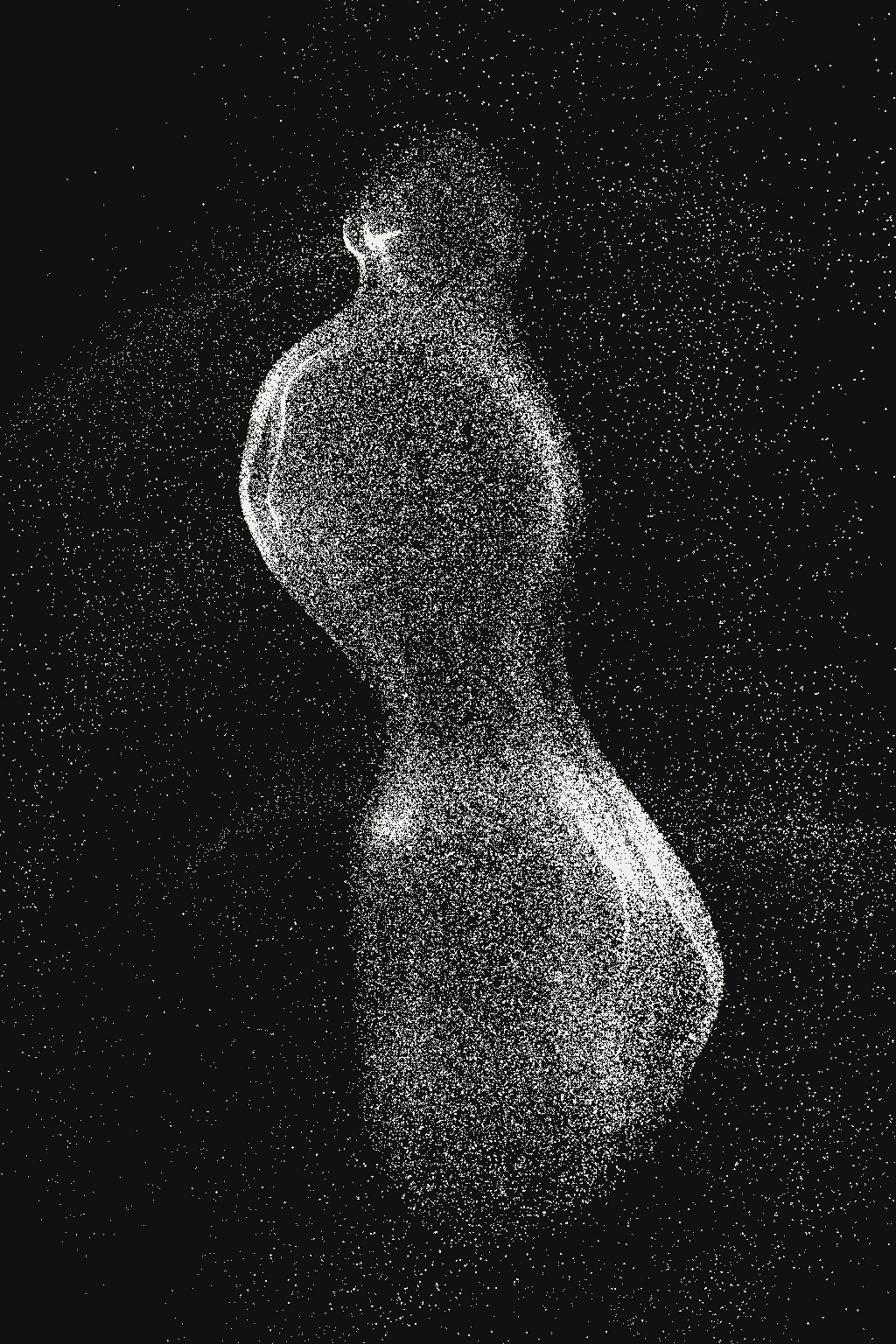
- SDF attractor — particles are pulled toward the surface of a signed distance field, which is what makes the cloud read as a figure instead of a blob.
- Additive splatting — points are rendered as tiny additive quads into a half-float target, then tonemapped before the shared dither pass.
What to look at
The figure never holds still: it is constantly dissolving at the edges and re-forming as recycled particles fall back toward the attractor. Hover to push a repulsor through the volume.
On WebGL2 there is no compute, so this preview falls back to its poster.